Protonation and magnesium ions shape the transition state diversity of phosphoanhydride hydrolysis in water
Abstract
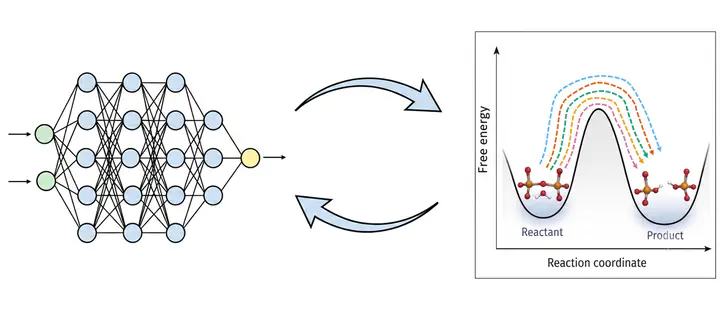
Phosphoanhydride hydrolysis is a central reaction in biochemistry, powering processes from biosynthesis to molecular motors. Yet, its solution mechanism and the molecular origins of the catalytic effects of protonation and magnesium ions remain elusive both to experiments and simulations. Here we use machine learning potentials trained at density functional theory accuracy combined with extensive reaction path sampling and free-energy methods to dissect pyrophosphate hydrolysis in solution, a model for ATP and GTP reactivity. Our simulations reveal multiple mechanistic pathways and identify a dominant mechanism involving synchronous P-O bond formation and cleavage, followed by solvent-assisted proton transfer. Protonation and Mg²⁺ coordination both stabilize tighter transition-state ensembles and lower activation barriers, although our simulations show that the intrinsic catalytic effect of the metal ion has been overestimated. These results establish the key drivers of phosphate hydrolysis.

Adrián García-Martínez
PhD Student

Kirill Zinovjev
Group member