Tuning the ZIKV NS3 Helicase Motor Activity through Magnesium Coordination and RNA-Driven Allostery
Abstract
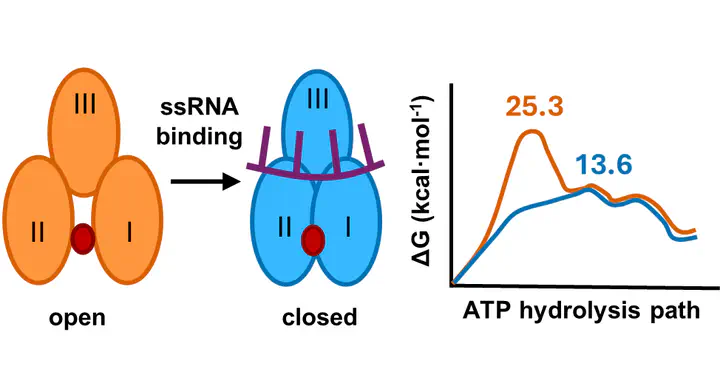
Viral NS3 helicases convert the chemical energy of ATP hydrolysis into directional motion along nucleic acids, but the molecular basis of this coupling remains unclear. Here, we combine AI-based structural modeling, molecular dynamics simulations, and hybrid QM/MM free energy calculations to investigate ATP hydrolysis in the Zika virus NS3 helicase (ZIKV NS3h). We first address the structural limitations of the available ternary crystallographic structure, which displays a noncanonical ATP-Mg²⁺ coordination mode and an RNA-binding arrangement inconsistent with the expected ATP-bound state. Our simulations show that alternative ATP-Mg²⁺ coordination modes can form stable but less favorable local minima, potentially associated with the secondary pyrophosphatase activity reported for this enzyme. Instead, the AlphaFold-predicted ternary complex provides a catalytically competent model with canonical coordination and the expected two-nucleotide separation between conserved “pincer” residues. We then use this model to explain the origin of RNA-stimulated ATPase activity. In the absence of ssRNA, the ATPase active site samples a broad conformational ensemble dominated by open, catalytically impaired states. Binding of ssRNA restricts this landscape and stabilizes a closed conformation in which the catalytic motifs are properly aligned. QM/MM free energy profiles show that the open state is effectively inactive, whereas the closed state lowers the activation barrier for ATP hydrolysis by optimizing active-site interactions with ATP and the nucleophilic water molecule. These results rationalize RNA-stimulated ATPase activity as an allosteric conformational selection mechanism that links RNA binding to optimal organization of the ATPase active site.

Adrián García-Martínez
PhD Student